
Humanistic Therapy: A Gentle, Powerful Path to Becoming More Fully Yourself
Carl Rogers
In today’s world of “three-letter therapies”—CBT, DBT, ACT, ERP, and others—highly structured, manualized approaches are incredibly effective at reducing symptoms quickly. They’re organized, time-limited, evidence-based, and relatively easy to learn and apply. Because they work so well for symptom relief, these methods often dominate conversations about therapy..
Yet many people come to therapy wanting more than symptom management. They long to understand who they are beneath the anxiety, depression, or relationship struggles—to discover a deeper sense of purpose, authenticity, and meaning. This is where humanistic therapy, pioneered by Carl Rogers in the 1960s, remains one of the most powerful and enduring approaches.
“Rogers’ ideas evolved and inspired related approaches, many of which operate on similar client-centered, non-directive principles: Gestalt therapy, Logotherapy (Viktor Frankl), Emotionally Focused Therapy (EFT), Interpersonal Therapy, Narrative Therapy, and Transpersonal Therapy.”
Rogers believed traditional psychoanalytic therapy, with its hierarchical “doctor knows best” dynamic, placed too much authority in the therapist. He argued that each person is the true expert on their own experience. Given a safe, non-judgmental, and deeply supportive relationship, humans naturally move toward healing, growth, and flourishing. Rogers called this innate tendency the actualizing tendency—a built-in drive toward becoming more whole.
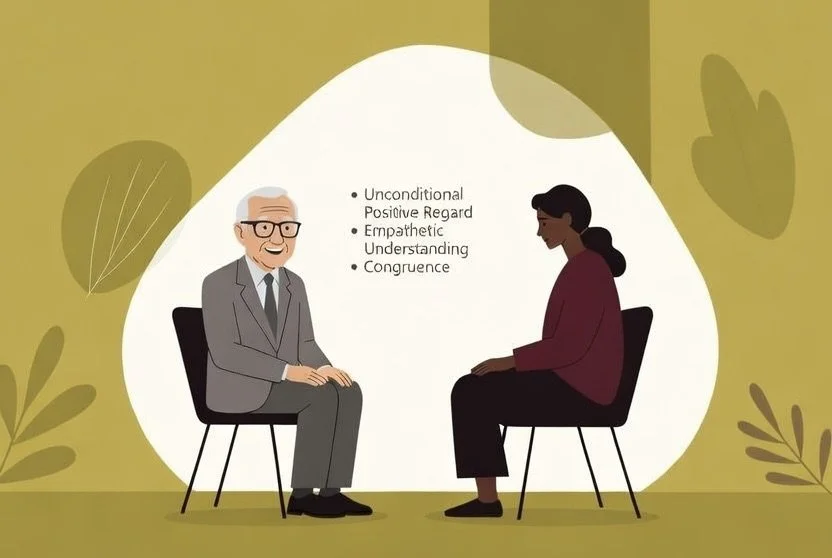
His person-centered (or humanistic) therapy rests on three core conditions:
Unconditional Positive Regard — The therapist meets you exactly where you are, accepting you fully, without judgment or conditions.
Empathy — The therapist steps into your world, reflecting back what you say with such accuracy that you feel truly understood.
Congruence — The therapist is genuine and transparent, modeling authenticity. Over time, this helps you align what you say, feel, and do—creating a more authentic, congruent self.
The famous 1965 “Gloria” demonstration video (still widely watched) beautifully illustrates this process. In just a short session, Gloria begins to glimpse her true self and how she might bring that self into the world—simply through being deeply heard.
https://youtu.be/2NQ4Osa0kzc?si=JrU6m3F0ogvxf8yn
Over the decades, Rogers’ ideas evolved and inspired related approaches, many of which operate on similar client-centered, non-directive principles: Gestalt therapy, Logotherapy (Viktor Frankl), Emotionally Focused Therapy (EFT), Interpersonal Therapy, Narrative Therapy, and Transpersonal Therapy.
At Forma Counseling, we specialize in several of these depth-oriented methods:
Logotherapy (Frankl) — Developed after Frankl’s concentration-camp experience, it emphasizes that meaning is the strongest force for resilience and perspective, even in suffering.
Existential Therapy — Draws on philosophy to help you face core human realities (death, isolation, freedom, meaninglessness) and take responsibility for creating a life of purpose.
Emotionally Focused Therapy — Focuses on transforming negative communication cycles into secure, supportive bonds by addressing emotions and attachment needs—especially powerful for couples and families.
Transpersonal Therapy — Honors the spiritual dimension of experience, inviting clients to connect with their own wisdom, sense of transcendence, and deeper meaning (ideal for those who find comfort in spirituality or philosophy).
John, our existential/humanistic therapist, brings extensive training from the Center for Existential Analysis & Logotherapy and integrates Logotherapy, and attachment insights to help clients build self-understanding and find meaning. John employs Emotionally Focused Therapy in couples’ counseling to foster and cultivate healthier relationships.
Sevilla leans deeply into person-centered principles, offering unconditional positive regard and guiding clients gently toward authenticity and congruence. She has a profound respect for spirituality and believes those who draw strength from it deserve to bring that dimension fully into therapy—making her a passionate practitioner of transpersonal approaches.
At Forma, we continue to hold person-centered therapy at the heart of our practice. While structured methods excel at symptom relief, Rogers’ approach invites something more: the discovery of who you really are. Congruence—when what you think, feel, say, and do finally aligns—opens the door to a deeply meaningful and satisfying life. That is our mission: not just to ease distress, but to help you live more authentically and purposefully.
If you’re ready to explore beyond symptom management, we’d be honored to walk with you.
